
The desk job - how your body pays
Sitting for hours on end at your desk might feel normal, but your body pays the price. From neck and back pain, to serious health risks like cardiovascular disease, prolonged sitting takes a toll. Learn how to keep your body moving and minimise the impact of a sedentary workday.

Sedentary Society
As a society, we are increasingly spending more time seated. One of the main causes of this change is a greater exposure to sitting during the workday. A study of 50 office workers has shown that Australians may accumulate up to 7.3 hours of sitting each day whilst at work, contributing to around half of their weekly exposure to sitting. Adding to this problem, prolonged periods of continuous sitting (greater than 30 minutes) whilst at work are quite common. These uninterrupted bouts of sitting are thought to be just as harmful as our total time spent seated.
The cost of sitting
Unfortunately, increased sedentary time has been associated with a range of poor health outcomes. These include conditions like cardiovascular disease, diabetes, obesity, cancer and mental health. Furthermore, a large study of 200,000 Australians found that sitting for 8 to 11 hours per day increases your risk of death by 15%! This is particularly concerning as the average Australian is already accumulating 7.3 hours of sitting whilst at their desk job. Considering the commute to work and some time spent on the couch, most Australian desk workers are likely to already fall within this range.
Your body is designed to move!
You may already be experiencing some of the costs of prolonged sitting in the form of shoulder, neck and back pain or stiffness. This may be the result of increased spinal loading in the seated position. Maintaining a static posture places prolonged stress on your muscles and ligaments. As a result, pain pathways are stimulated which can cause exhausting discomfort in your body. Luckily there is one simple way to resolve this issue… move! Moving has endless benefits; it increases muscle activity and therefore promotes blood circulation. Activity also allows the body to expend energy, which can help reduce blood pressure, cholesterol levels and fat deposits. All in all, motion is lotion and the more you can get of it, the better!
Key aims
There are two key aims in reducing sitting time during work:
- Reduce the accumulation of seated tasks throughout the day.
- Interrupt long periods of sitting as frequently as possible.
Consider the tips below to get your body moving during the workday:
1. Set a 20-minute timer on your phone. Every time it goes off, stand up!
- This simple change in posture has been shown to reduce that familiar shoulder and back tightness.
- This is a great opportunity to implement the “back arch” shown in the next section.
2. Include walking throughout the day at every opportunity. For example, choose to walk to get your morning coffee, rather than taking the car.
- Despite being a very simple and low intensity exercise, walking has many health benefits.
3. Begin to substitute sitting with standing, wherever possible. Standing may provide a healthy alternative to sitting during productive tasks. For example:
- Stand whilst taking any phone calls
- Stand on public transport during your commute
- Stand during online meetings
4. Include some mobility or stretching exercises throughout the day - many of these can be done seated.
- See the examples below for some exercises which help to target muscles which may become irritated during sitting.
Example exercises
If possible, try to implement these exercises three to four times daily. However, there is no specific amount required here. Experiment and find what works for you.
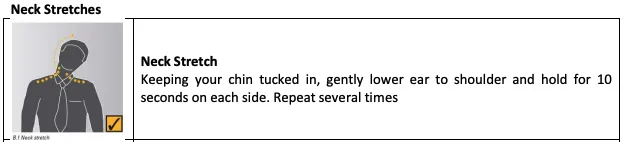
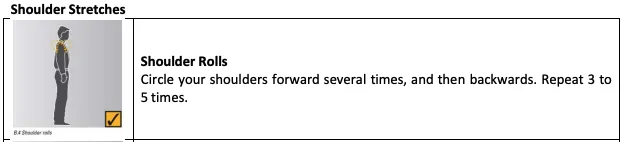
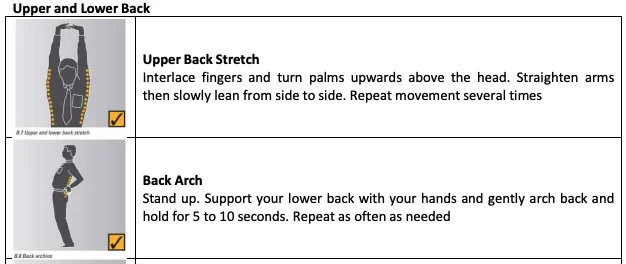
Exercise illustrations: Northern Health - ergonomics stretches and exercises (PDF)
Standing desks
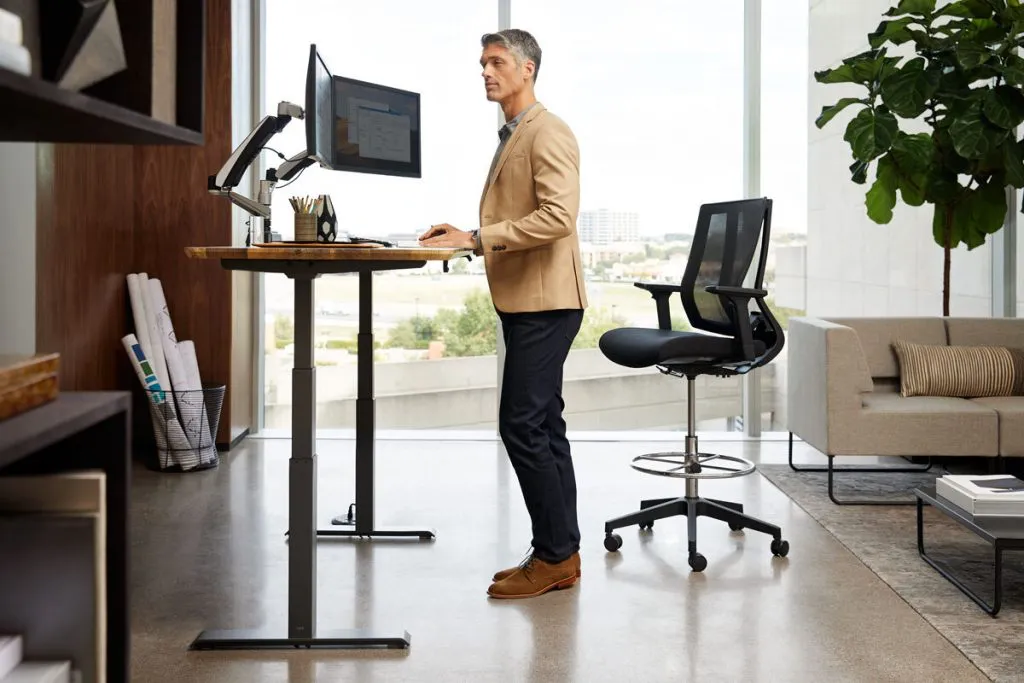
Many workplaces and home offices are beginning to implement standing desks. Whilst they are not essential and can be quite costly, there is some evidence which demonstrates that standing desks can be useful in reducing the effects of a sedentary desk job. Consider speaking to your employer to get them on board and help implement this equipment into your workplace.
It is important to note that an entire day of standing may actually cause discomfort in the lower limbs. In fact, maintaining any one position for an extended period will likely cause pain. The key here is variation! For example, you may want to begin by alternating between 30-minute bouts of sitting and standing. This has been shown to reduce neck and back pain in desk workers.
Desk ergonomics
As mentioned earlier, the key to minimising harm from your desk job is to reduce the amount of time spent sitting. However, when you do have to remain seated to work, it is important that your desk setup suits the ergonomic needs of your body. This video from WorkSafe is a great place to start!
References
Agarwal, S., Steinmaus, C., & Harris-Adamson, C. (2018, Apr). Sit-stand workstations and impact on low back discomfort: a systematic review and meta-analysis. Ergonomics, 61(4), 538-552. https://doi.org/10.1080/00140139.2017.1402960
Biswas, A., Oh, P. I., Faulkner, G. E., Bajaj, R. R., Silver, M. A., Mitchell, M. S., & Alter, D. A. (2015, Jan 20). Sedentary time and its association with risk for disease incidence, mortality, and hospitalization in adults: a systematic review and meta-analysis. Ann Intern Med, 162(2), 123-132. https://doi.org/10.7326/m14-1651
Da Costa, B. R., & Vieira, E. R. (2010, Mar). Risk factors for work-related musculoskeletal disorders: A systematic review of recent longitudinal studies. Am J Ind Med, 53(3), 285-323. https://doi.org/10.1002/ajim.20750
Davis, K. G., & Kotowski, S. E. (2014, Nov). Postural variability: an effective way to reduce musculoskeletal discomfort in office work. Hum Factors, 56(7), 1249-1261. https://doi.org/10.1177/0018720814528003
De Rezende, L. F., Rodrigues Lopes, M., Rey-López, J. P., Matsudo, V. K., & Luiz Odo, C. (2014). Sedentary behavior and health outcomes: an overview of systematic reviews. PloS one, 9(8), e105620. https://doi.org/10.1371/journal.pone.0105620
Fenety, A., & Walker, J. M. (2002, Jun). Short-term effects of workstation exercises on musculoskeletal discomfort and postural changes in seated video display unit workers. Phys Ther, 82(6), 578-589.
Hanson, S., & Jones, A. (2015). Is there evidence that walking groups have health benefits? A systematic review and meta-analysis. British Journal of Sports Medicine, 49(11), 710. https://doi.org/10.1136/bjsports-2014-094157
Howard, B., Winkler, E. A., Sethi, P., Carson, V., Ridgers, N. D., Salmon, J. O., Healy, G. N., Owen, N., & Dunstan, D. W. (2015, Oct). Associations of Low- and High-Intensity Light Activity with Cardiometabolic Biomarkers. Med Sci Sports Exerc, 47(10), 2093-2101. https://doi.org/10.1249/mss.0000000000000631
Katzmarzyk, P. T. (2014). Standing and mortality in a prospective cohort of Canadian adults. Med Sci Sports Exerc, 46(5), 940-946. https://doi.org/10.1249/mss.0000000000000198
Levine, J. A., Schleusner, S. J., & Jensen, M. D. (2000, Dec). Energy expenditure of nonexercise activity. Am J Clin Nutr, 72(6), 1451-1454. https://doi.org/10.1093/ajcn/72.6.1451
Parry, S., & Straker, L. (2013). The contribution of office work to sedentary behaviour associated risk. BMC Public Health, 13(1), 296. https://doi.org/10.1186/1471-2458-13-296